
The Fisher King: Hilarious, Heartbreaking, Heartfelt
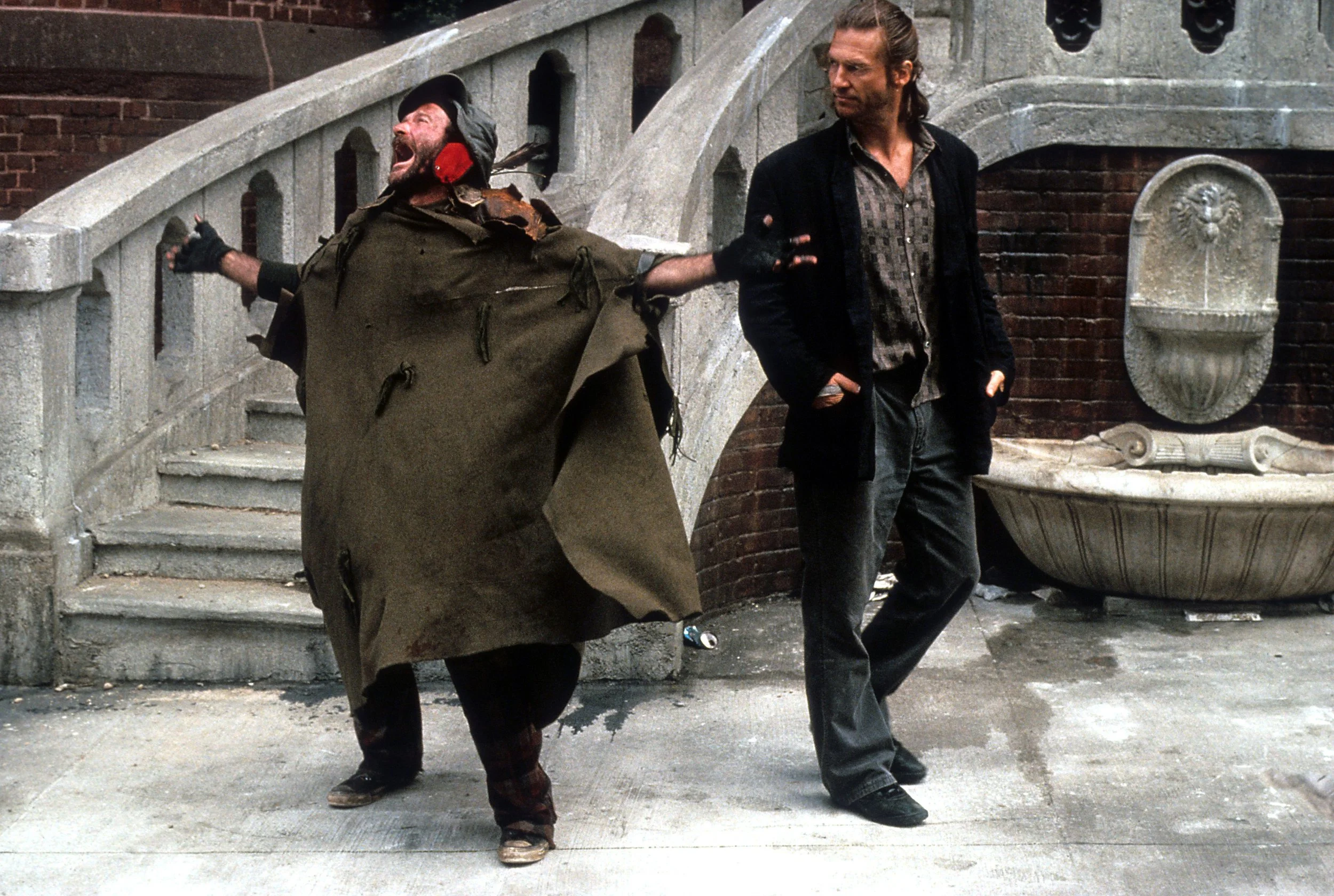
©1991 Tri-Star Pictures. All Rights Reserved.
The Fisher King is a medieval legend in the Arthurian Legend, a girthy collection of literature written around the time of King Arthur that follows the stories of heroes. Fisher King was not one of these heroes— in fact, he’s desperately in need of one. He sits in his castle with a badly wounded, never mending leg. The Fisher King is helpless and his land barren; he awaits a knight who will bring him the Holy Grail, healing him and returning prosperity to his kingdom. Gilliam’s The Fisher King has all of the same elements as the original tale but unfolds as a modern retelling that transforms present-day New York City into a mystical place with 455 Central Park West as a contemporary castle, and Sheep Meadow substituted for ancient sylvan woods. The man who is sent on a ‘quest’ for the Grail is no brave and knightly Perceval, but rather a bombastic, petulant egomaniac we are (at first) forced to call the hero
I thoroughly enjoyed The Fisher King; it’s a hilarious movie, it’s a heartbreaking movie, and a philosophically rich one too. The Fisher King follows Jack Lucas (Jeff Bridges), rich, famous, egoistical radio show host, and his descent into guilt over the predatory way he makes a living. He meets Perry (Robin Williams), a homeless man with schizophrenia, and the two’s lives begin to intertwine. This movie is all about rotten people who have it good, and good people who have their lives ruined by the rotten ones. There’s a lot of themes surrounding redemption, forgiveness, love, insanity; the struggle to move on past the bad. This is life and The Fisher King shows us extraordinarily well how windy the road up and down it is.
I’m a big Terry Gilliam fan. I adore him for his well known role in the comedy troupe Monty Python, along with his directing feats featuring Criterion-worthy hits like Brazil , Fear and Loathing in Las Vegas , and 12 Monkeys. Gilliam is a great director; right in line and as renowned as Coppola, Lynch, Scorsese, Tarantino, etc,. His cinematography is simply unmatched, and that is clear in The Fisher King. Dutch angles that focus on shadowy characters under modern, art deco or nouveau buildings; encompassed by smoky hues of red, blue and purple— that is unmistakably Gilliam. He makes movies that I can only describe the genre of as ‘adult whimsicality’ , and The Fisher King expands his filmography under this faux-titled classification.
Most of Gilliam’s works take place in fantastical realities with dark, creeping metaphorical shadows overlaying the world. Many of his main characters are on the mentally ill side. The Fisher King is all of that, but the tone is all over the place too. For many this is a draw not a plus, but personally it’s what I felt made the movie so great; it has everything.
There’s trashy bits like most scenes with Mercedes Ruehl’s character who’s a mock up of a Jersey Shore housewife. These bits are followed by heart shattering moments that delve into Perry and his past, and those are trailed by comedic, light-hearted scenes with Jeff Bridges’s character. There’s cartoonish fog and colorful lights; there’s dancing and mythical creatures and, of course, the Holy Grail. Yet there’s also realism in sets of New York City’s grimy hospitals and sterile corporate offices; in the sad sight of homelessness at Grand Central station.
It’s a perfect parallel to the medieval story. Perry as a wounded, scarred man pining for emotional rescue under the guise of assistance in reaching the Holy Grail, and Jack as a hero who, despite his pompous beginnings, manages to develop and display true compassion— they are vessels for the lessons in the legend. Although the original tale is more about being on the receiving end of aid, Gillian’s version really hones in on the fact that the results go both ways. You get what you give, as the saying goes, and when you give help you tend to feel as though you, yourself, have received just that. The human experience is all about give and take.
Gilliam manages to cram everything- and I mean everything- from religious messaging, to relationship advice, to analysis of varying human archetypes, into a two hour experience. All of that makes it feel very real (and very hard to write about) because it’s just as messy as the real world.
Life can be overly whimsical and you might be seeing it as that— only seeing in a form of quasi-reality like poor, downtrodden Perry. Or despite being part of the upper crust like Jack, you may see the true grit and muck of the city you live in, in the thugs that roam dark, cramped back alleys or in broad daylight by the poor man yelling at the corner of Broadway and 5th Ave. There’s trashy Jersey Shore housewives, and heart wrenching homeless veterans; lonely eccentric career women, and soulless corporate yuppies. But at the end of the day we’re all human beings and we have the same fundamentals to worry about— at least most of us do. How can I be less of an asshole? Am I loved? What’s the point of all this?
What needed to happen, happened, in the end. There was a redemption arc for Jack Lucas, in fact, a faux redemption arc followed by a real, genuine one. That fake arc is highly appreciable— most real life absolutions are not a linear upward climb, and a common experience is readmitting yourself back into a life that was just plain wrong only to feel that the welcome back is not so welcome. Instead the ‘this isn’t right’ feeling becomes palpably strong and impossible to readjust to.
Perry recovered from his issues and faced his past, Anne finally receives the ‘I love you’ she deserves, and Lydia experiences dating in a way much more pleasant than most people’s first attempts. Everyone got what they needed and all was resolved.
My one qualm was with the last scene: Jack and Perry lie nude in Central Park under the starry night sky, a fireworks show lighting up the skyline, with a gushy ‘the End’ spelled out of the bursts, accompanied by Disney-esque violins, harps and piano. This was really overwhelming, however I later learned that Gilliam was pushed in that specific direction.
But the necessary element— a happy ending— was still there at the end. Gilliam does a great job funneling dark and dimly toned content into a tunnel that opens up into brightness. The Fisher King, despite its ups, has so many downs. If Jack didn’t redeem himself then the point would have been lost there. If Perry didn’t recover, that point would also get muddled. If Anne didn’t get what she deserved despite being the woman she was, and if Lydia ended up a lonely cat lady instead of happily in love, this movie would become the Requiem of a Dream of mental problems and corporate sell-outs.